First dear readers, I would like to state that I am freshly returned to the U.S. from the Turks and Caicos Islands, so while I have decided to break down the remainder of my posts into different sections of my study abroad experience, I will be referring to many of these events in the past tense. Anyways, on with the post!
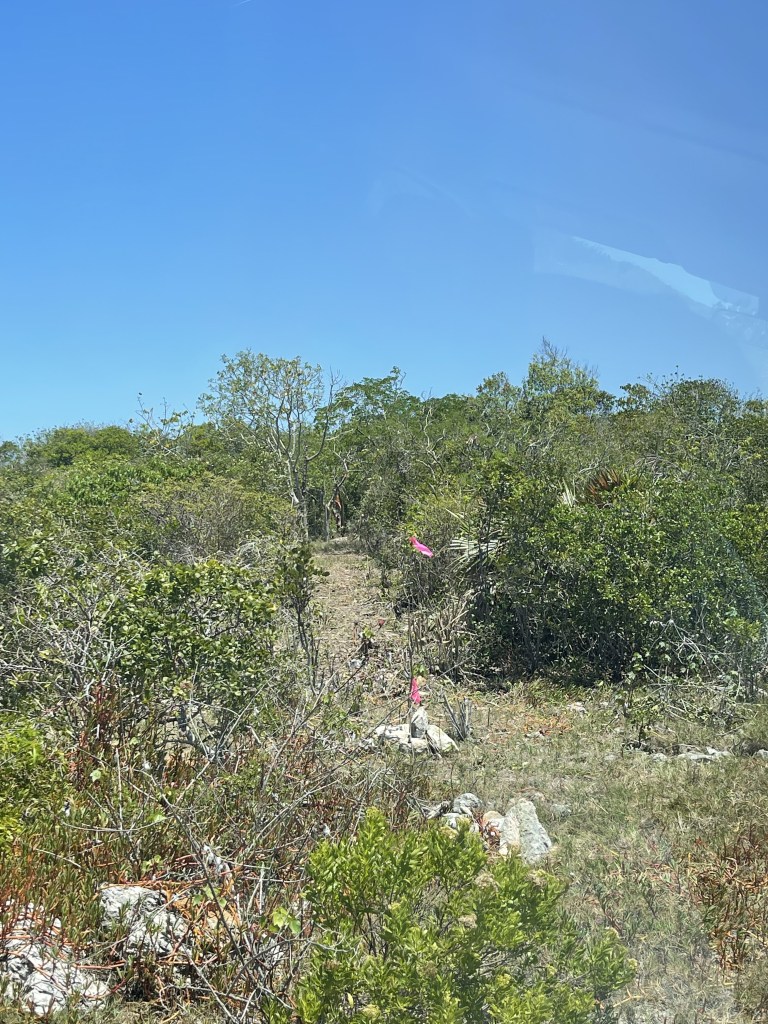
While Steven Spielberg’s Indiana Jones may believe that 70% of archaeology is done in the library, I am of the opinion that 70% of all field archaeology is yard work. From the very first day we spent in the field, we were clearing brush and creating transects. Transects are paths across the site that allow the dig team to travel between different sites or units being excavated. All of the transects are carefully mapped out from a central point.
Imagine the site of Palmetto Junction as a large grid that covers all of the land. Each square of the grid is 1×1 meters wide. By using a compass and coordinates from a known location, one can calculate the exact position of a singular point throughout the grid.
On the very first day at the site, we began clearing the transects cut by the teams of previous years as Dr. Sinelli and his PhD student Mel Gomez used a measuring tape, compass, and marker flags to set up a series of grids that would allow for whatever units we opened up to be properly labelled. The first location we cleared had a main point, a datum point, from which every other point across all of Palmetto Junction would be measured. Given his experience, it was so fascinating watching Dr. Sinelli stand in a straight line, use his compass and simply by measuring from a single point calculate the distance of a transect within 2 centimeters of his previous years’ notes.
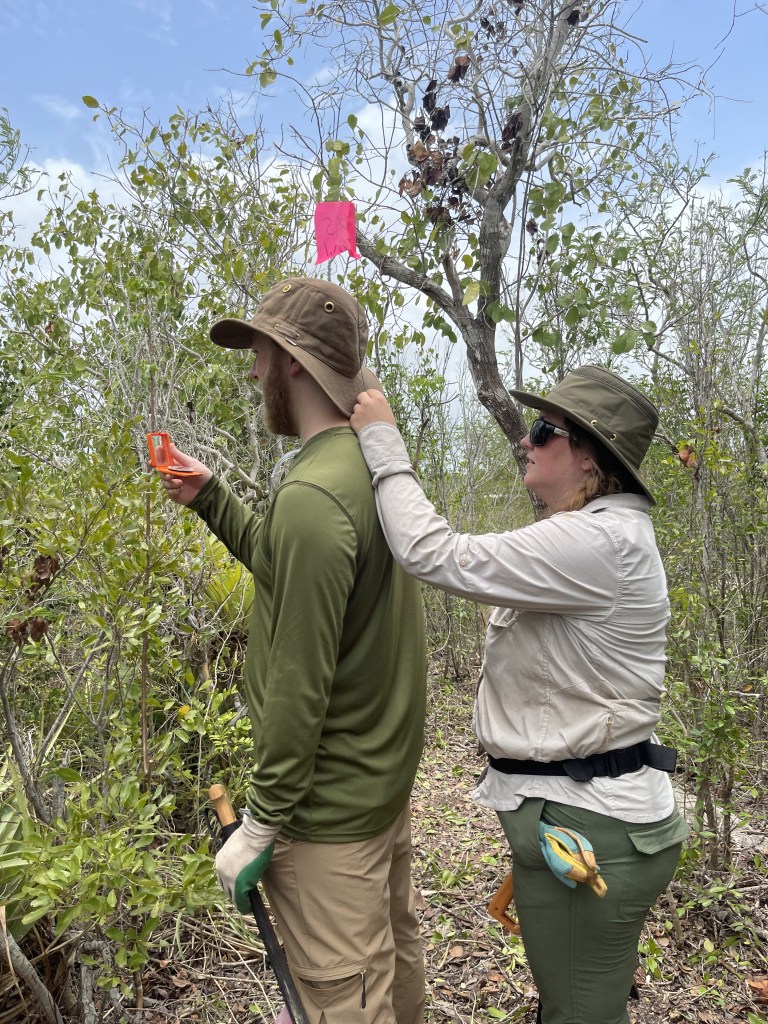
These transects of course have more uses than simply allowing for us to simply walk along the grid of the site and move between units. After we began excavating one section, based on the artifacts we were finding across the first units, Dr. Sinelli’s previous interpretation of the site as a whole began to shift. Clearing more transects later in the dig meant that he could see from one end of where we were digging to a part of the site, he had previously believed to have been a plaza or housing area. As an expert in settlement patterns, he could hypothesize how the site would have been utilized during the time it was occupied by the Taino-Lucayan peoples as well as how the modern construction of the road that revealed Palmetto Junction in the first place impacted the site’s layout and provenience.
So back to the yard work, we used a variety of tools to clear vegetation. Using hand clippers, our hands, and the most dramatic tool on our school supply list: a machete made up the entirety of our first week out in the field. I was lucky enough (or unlucky enough) to continue to be a part of the elite A-team of transectors who was tasked with helping clear out more of the site throughout the later weeks. It led to some steadfast friendships as we bonded over the hardship of machete-ing in the heat, even on our days off.


 Baking the Past