As far as Study Abroad experiences go, an archaeological dig in the Turks and Caicos Islands sounds like a dream. White sandy beaches, great food, and plenty of relaxation… or that’s what it was supposed to be.
In reality, this experience has been anything but relaxing, it’s been some of the hardest most back-breaking physical labor I’ve ever done. I consider myself to be pretty well-versed in physical labor from my experience in Living History farms and working in zoos as a keeper intern, but I have never been more exhausted in my life. Of course, this is a good kind of exhaustion. Even though we leave for the site at 6:45am each morning, I find myself genuinely excited for every task we do whether that’s clearing brush, digging in holes, assisting with measuring, or screening for artifacts. I am a full-body experience kind of person. I like interacting physically with the past and through this experience I have been able to directly do that.
The weather in TCI is beautiful… if you’re actually vacationing, however when wearing hiking boots, work clothes, and carrying a backpack that contains among other items: a first aid kit, poisonwood scrub and cleanser, digging equipment, hand clippers, and a machete, the morning cool ends quickly and as the temperature rises throughout the day, it becomes miserable. In addition to the weather, the location of our dig is also a compounding factor in what makes digging in the Turks and Caicos Islands difficult. On the very first day we were out in the field, my trusty Merrell hiking boots of 14 years decided to break. It was absolutely devastating, but I was able to get ahold of some Gorilla Glue and I reattached my boots and got back to digging the next day.
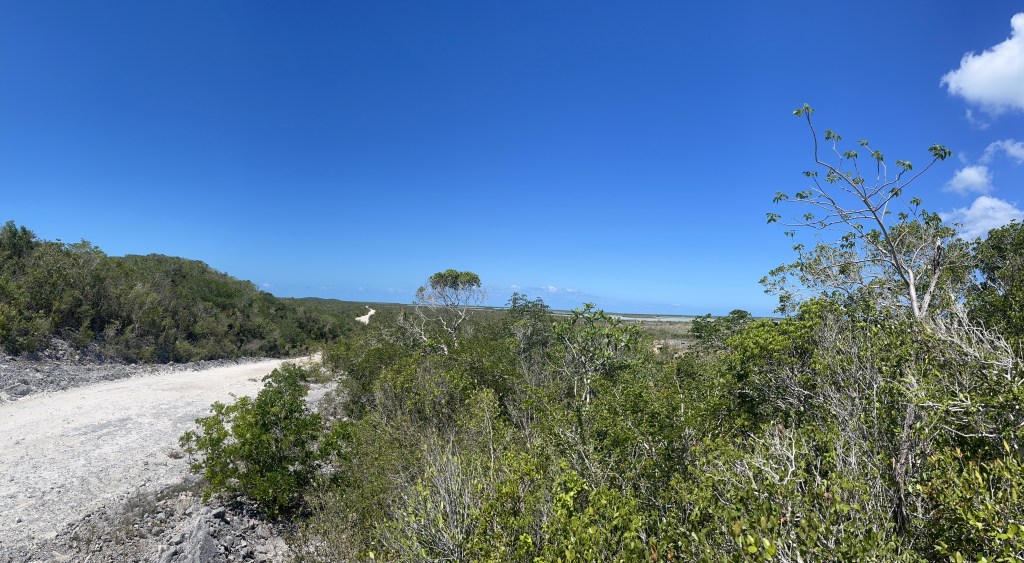
Initially discovered in 2005, Palmetto Junction is the site of a Lucayan-Taino settlement on the island of Providenciales. It was unearthed during road construction and boasts some incredibly interesting site features that show how the people who occupied the area, roughly between the years of 1300-1480 CE, adapted to their environment in unique ways. The site is at the center of a collection of almost every marine ecosystem you could possibly think of with a river that could take people directly to the ocean from the salina that borders the site. On the Eastern side of the road now crossing through Palmetto Junction, salt pans accumulate making this area a rich source of sodium for those inhabiting the coastline and providing a resource that could be traded or sold throughout the Bahama Archipelago.
As a team excavating this site, we interact with the different plants and features left from the time the Taino occupied Palmetto Junction and those that have grown in the area over the past 700 years. One of the most confusing to me has been the presence of cacti in an area that I would not associate with cactus growing at all. However, just the other day I had a full-on encounter with one when I managed to kneel on a cactus while attempting to assist in clearing a transect, a path between excavation units.

 Baking the Past