All good things must come to an end, and the same can be said of any archaeological dig. At least for the season. During my three-week stint at Palmetto Junction I got the chance to assist in the excavation of a midden that totally changed the interpretation of the site that Dr. Sinelli had taken students on for multiple dig seasons in the past decade. As with history, each excavation allowed for the information that was gained to change the way that the Taino inhabitants of the site lived and worked, but by only uncovering small sections across the site, the understanding of Palmetto Junction could be studied further by future archaeologists with better technology and better resources.
Knowing that you need to leave something undiscovered for others to investigate might seem difficult, especially to those of us who grew up with Indiana Jones or The Mummy and once we started excavating just wanted to keep digging. However, the experience of excavating and learning how artifacts are interpreted and preserved gives you a sense of respect for the process and how each important detail of careful excavation lends itself to taking the time to understand exactly what you’re looking at.
Of course, that begs the question, how do you know where to dig for future dig seasons? By digging test pits.
After about 2 1/2 weeks of consistent excavation, Dr. Sinelli began to slow down the growth of the units. He had us close up ,or stop digging in, several of the units that we had opened at the beginning of the season because we had hit bedrock. Then he pulled those of us who had helped with transecting during lab days to assist in doing an archaeological survey of the very paths that we had cut through the jungle. This involved someone holding the mobile data that had been made at the beginning of our transecting adventure and then using an extremely long tape measure to measure out a distance of about 100 meters. Then another student would place flags every 10 meters after the exact geographical coordinates were printed on each of the flags.
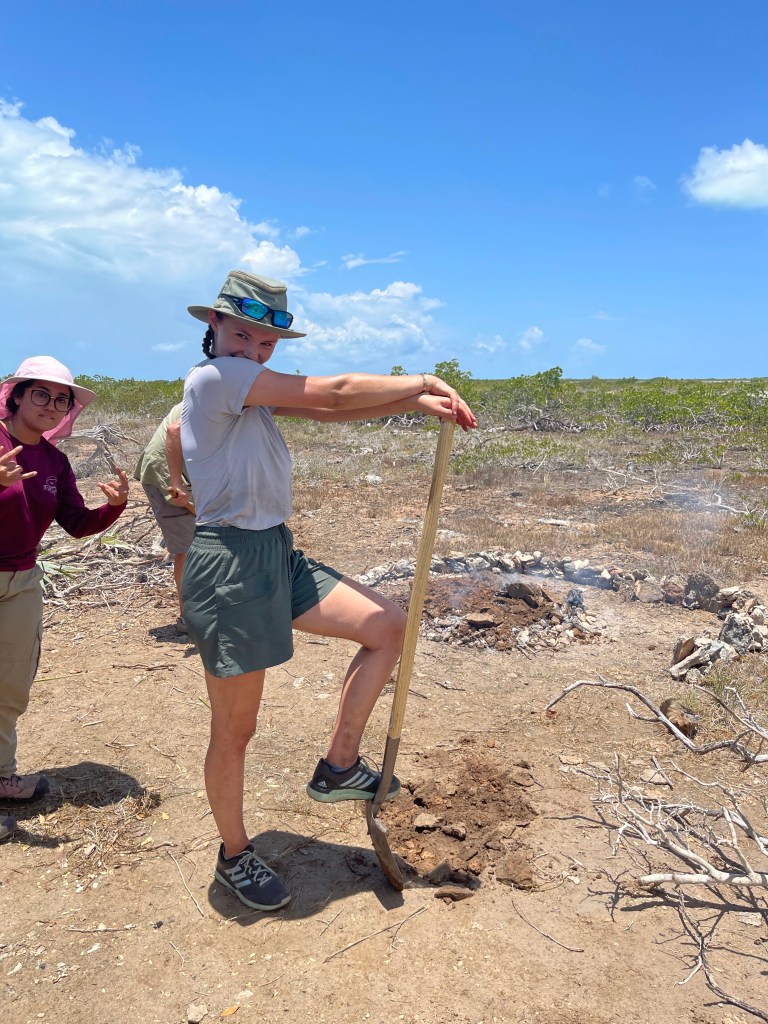
Another group of students would then use a shovel to dig a small 12 inch circle down to the bedrock. The dirt from these small holes was collected and screened just as the units were and any artifacts that were found within the test pit was bagged and tagged with the exact coordinates from the flag to the corresponding hole. In one section of test pit we found absolutely nothing. For those of us who were digging at the time it was incredibly frustrating.
A few weeks later when Dr. Sinelli came to speak at my museum. He informed the audience that he had in fact been looking for nothing in this one specific area. He stated that the lack of artifacts in this area meant that this flat part of land, that had no cultural material whatsoever, was in fact a central plaza. To me, this was incredibly mind-blowing because in the field I simply remembered being jealous and irritated that we were finding nothing in every hole we dug when the next test pit group only 10 meters over had found two bags worth of pottery sherds. Understanding how important test pits are to future excavations and the interpretation of an entire archaeological site helped me appreciate the knowledge that one can gain simply by taking the time to slow down and understand that what is found in the ground is not the only part of archaeology that matters. Sometimes no artifacts at all can be just as important to the understanding of a site layout.

 Baking the Past
Leave a comment