Examining the scale at which digital history projects are organized and the criticisms or compliments on their interpretations of history, is a worthy examination into the ideas surrounding ethical practice and good scholarship when operating in the realm of the digital humanities. In this period of rapid technological change there is a wealth of sources available to historians across the world on in almost incomprehensible scale. Attempting to engage with these sources in a meaningful way can be difficult and sometimes dangerous to widely accepted interpretations of historical events. Understanding and using these vast amounts of historical data in an ethical way is important for the field of digital humanities. Through this project I hope to spatially map the areas that are being studied by digital historians and then analyze how these projects have been received by the academic community at large. Common keywords of phrases are an intrinsic part of this analysis as I plan on examining the themes expressed across projects in order to see what consistent blind spots in digital history scholarship might be. It is only by seeing the frequency of the problems across projects that historians can work on solutions for a more moral or ethical way in which they approach digital history scholarship.
While there are hundreds, if not thousands of digital history projects across landscape of the internet, I plan on focusing my project on those discussed in this History in the Digital Age class, throughout our readings and those offered in discussion as well as the projects reviewed in the Journal of American History and mentioned in the AHR Exchanges. Alongside these projects I plan on including projects mentioned in my Spatial History class, and digital publications like the History Manifesto or Time On the Cross which had an extensive impact on the field of Digital History.
While initially planning on using WordCloud as the basis for my project, I do not believe that WordClouds is the right avenue to visualize the patterns of common words, due to word limits and a lack of proper way to calculate the frequency of common phrases. I now aim to first examine the scale at which projects are designed, mapping the communities/areas studied by these individual projects. The best format for my project, one that can include the use of maps, textual analysis, as well as images seems to be ArcGIS StoryMaps. I will plot the areas examined in each project, attempting to highlight the different scopes of the historical events of areas of geography that have been studied so far.
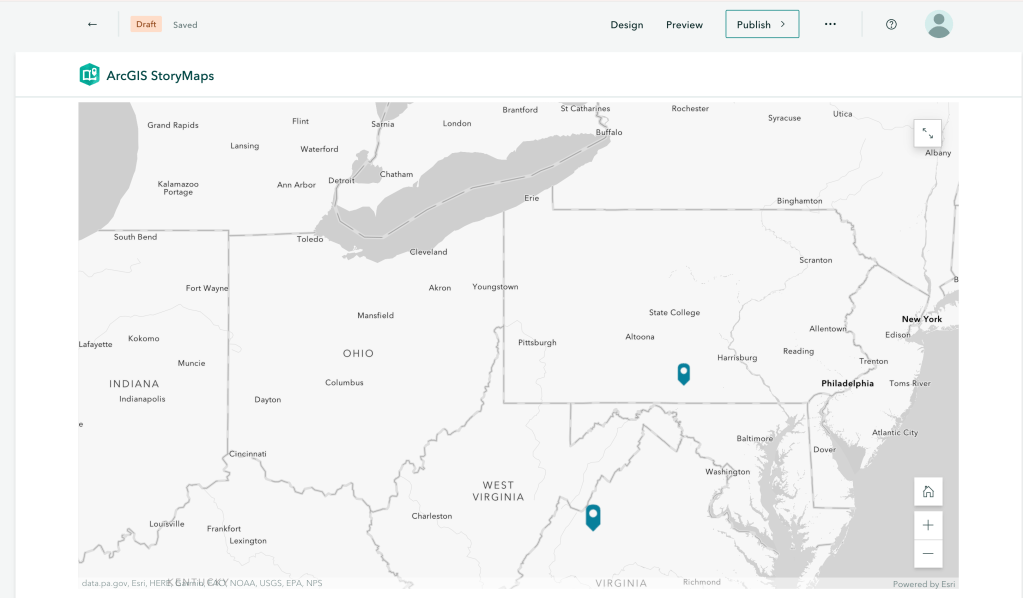
As an example, here is the beginning of my map for plotting the Valley of the Shadow project. I will plot the points, with an annotation of what each area represents, and hopefully I will be able to draw out the area studied, in this case the area being county lines. I will then attempt to group these points together. Then, I will provide a brief background on the reception of the project by examining the concerns or compliments of the project in any digital history reviews published in the American Historical Review Exchanges, or book reviews. While it will take some time for me to complete the maps, I believe that this will be a thematic interactive visualization that will show what the areas of time or geography most commonly use the medium of visualization or digital history as an avenue to share information.
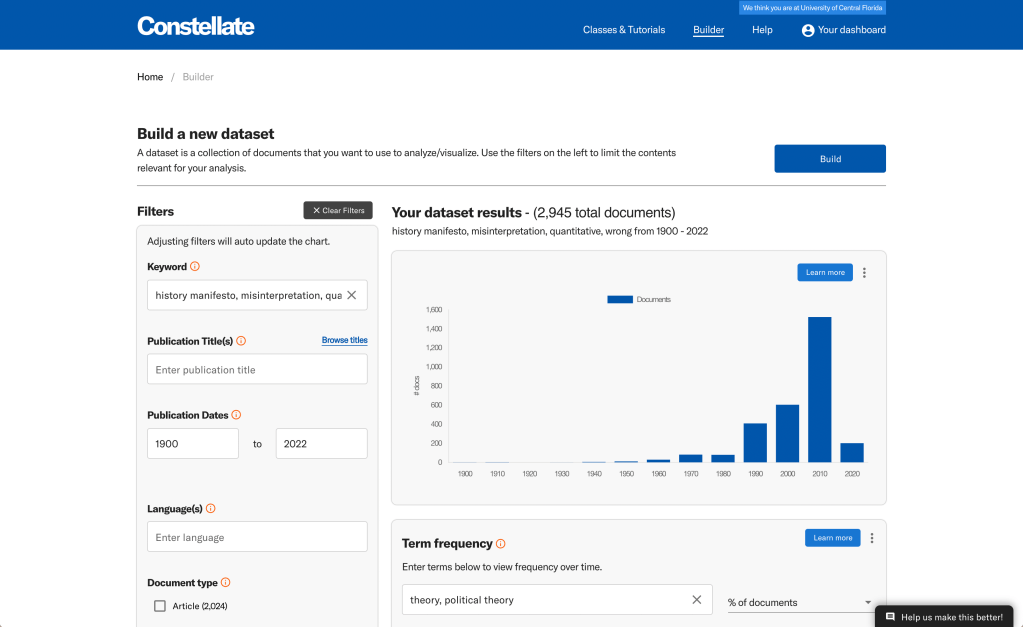
Using these selected works as a sample group, I plan on breaking down the common themes and phrases throughout these sources using textual analysis. I will also see if there are common themes within the JSTOR Data for Research tool Constellate to see if I can successfully text mine JSTOR for the frequency of these concerns mentioned in different journals. By cross-referencing these phrases I hope to examine how frequently specific “problems” within the digital historiography emerge.
Whether or not I am able to propose any solutions to these concerns remains to be seen, but I hope that by visualizing these projects and comparing them to one another, a better “formula” or understanding how large or small the scope of a well interpreted digital history project or work can be made clear.
Bibliography
Digital Projects
Vincent Brown, “Slave Revolt in Jamaica, 1760-1761,” Harvard University, 2012. http://revolt.axismaps.com/.
Guldi, Jo and David Armitage. The History Manifesto. 2nd ed. Online: Cambridge University Press, 2015.
Guldi, Jo and Benjamin Williams. “Synthesis and Large-Scale Textual Corpora: A Nested Topic Model of Britain’s Debates over Landed Property in the Nineteenth Century.” Current Research in Digital History 1 (August 27, 2018).https://doi.org/ https://doi.org/10.31835/crdh.2018.01. https://crdh.rrchnm.org/essays/v01-01-synthesis-and-large-scale-textual-corpora/.
Knowles, Anne, et al, Geographies of the Holocaust, Bloomington: Indiana University Press, 2014.
Thomas III, William G. and Edward L. Ayers. “The Differences Slavery Made: A Close Analysis of Two American Communities.” National Endowment for the Humanities. http://www2.vcdh.virginia.edu/AHR//.
Reviews and Essays
Cameron Blevins, “Valley of the Shadow and the Digital Archive Project.” Posted Dec. 19, 2009. https://www.cameronblevins.org/posts/valley-of-the-shadow-and-the-digital-database/.
Cohen, Daniel L., Rosenzweig, Roy. “Promises and Perils of Digital History.” Digital History: A Guide to Gathering, Preserving, and Presenting the Past on the Web. Center for History and New Media and Echo, 2006. https://chnm.gmu.edu/digitalhistory/introduction/index.html.
Jessica Marie Johnson, “Markup Bodies: Black [Life] Studies and Slavery [Death] Studies at the Digital Crossroads.” Social Text 1 December 2018; 36 (4 (137)): 57–79.
Robertson, Stephen. “Digital Mapping as a Research Tool: Digital Harlem: Everyday Life, 1915-1930.” American Historical Review. February (2016) 156-166.
Sternfeld, Joshua. Harlem Crime, “Soapbox Speeches, and Beauty Parlors: Digital Historical Context and the Challenge of Preserving Source Integrity.” American Historical Review. February (2016) 143-155.
Story, Daniel. Jessica Marie Johnson on the History of Atlantic Slavery and the Digital Humanities. American Historical Review Interviews. Podcast audio. February 21, 2021,https://www.historians.org/publications-and-directories/american-historical-review/ahr-interview.

 Baking the Past
Leave a comment