Much like the millions of websites that allow for massive amounts of data to be shared across space and time through the Internet, defining digital history is difficult and the meaning of it can be personal.
In todays’ era of social media and the technological globalization that is more available now than ever before, digital history sits in a unique position. As a discipline that encourages collaboration and open-access, Douglas Seefeldt and William G. Thomas attempt to define digital history as the publication of history with some form of interpretation or argument of a historical question on a digital platform. Others, they also argue might define it as a way of analyzing copious amounts of data found in online archives or organized by tools to create new understandings of history through the analysis, through textual or computational analysis. This latter definition becomes increasingly important when looking back at the origins of digital history.
In Thomas’s “Computing and the Historical Imagination,” digital history’s roots came from the idea of analyzing history purely as quantitative data. This idea was the premise for the now infamous book authored by Robert Fogel and Stanley Engerman, Time on the Cross: The Economics of American Negro Slavery, first published in 1974. This book took the economics of slavery in the South down to the bare bones numbers of slavery and then made interpretations based solely off the numbers. This book was met with severe and significant backlash from readers, criticizing the book for removing the “humanity” out of the humanities and for erasing the human aspect of this historical event. This landmark work on the timeline of digital history allows for readers to understand how the beginnings of the discipline and why the continued concerns about good and ethical digital scholarship are still topics of discussion within the field.
Highly populated digital realms like Instagram are perfect platforms for historians to engage with platform users in an impactful way. One of my favorite examples of a digital history project that utilizes social media is Eva. Eva, known as @eva.stories, is a memoir recorded and published through Instagram posts and stories in early 2019.
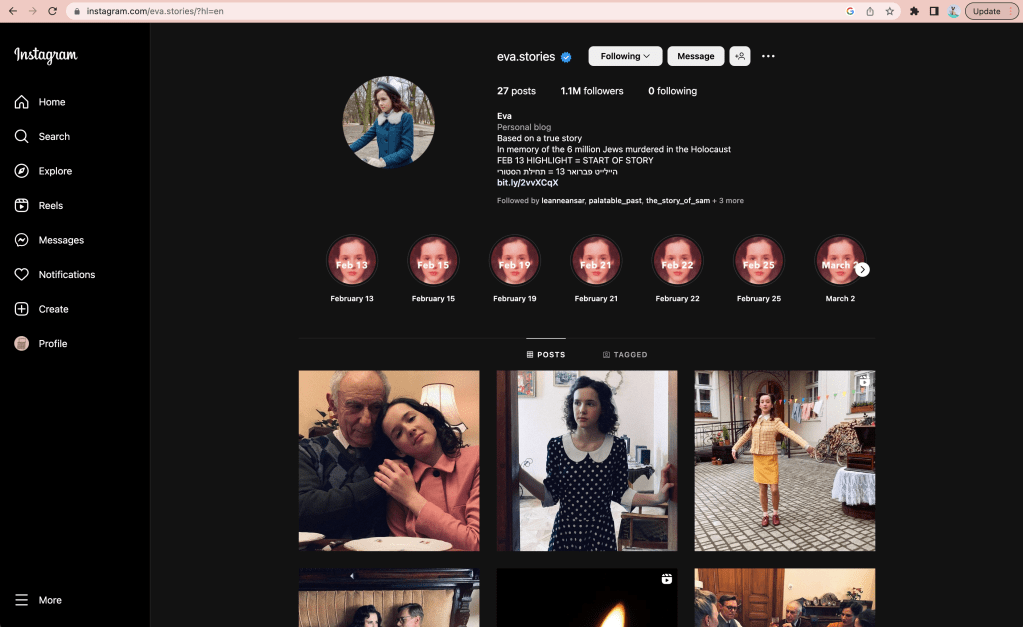
The project uses actors to detail the life and experiences of a 13-year-old Jewish girl living in Eastern Europe during the Holocaust. Alongside each of the stories are clips of archival footage and at the end of the project it is revealed that the story of Eva’s story is that of Eva Heyman, a Hungarian girl who was murdered in the death camps. While the message of the project is clear, one of Holocaust memorialization, the project’s unique use of social media as a platform can be seen as a great avenue for interdisciplinary collaboration in history that can make an impact world-wide. The eva.stories Project was shared by world leaders during the summer of 2019 and gained over 1 million followers online. Most importantly, it opened up conversations about Holocaust remembrance and how genocide history can and should be shared across generations.
This project, along with so many others is just one example of how the use of digital spaces by historians can create amazing projects and tools that can forward the field and allow more people than traditional academics access to the vast amounts of data, resources, and materials that make history the rich field of study it is.
Cauvin, Thomas. “Digital Public History.” In Public History. 174-187. 1st ed. New York: Routledge, 2016.
Cohen, Daniel L., Rosenzweig, Roy. “Promises and Perils of Digital History.” Digital History: A Guide to Gathering, Preserving, and Presenting the Past on the Web. Center for History and New Media and Echo, 2006. https://chnm.gmu.edu/digitalhistory/introduction/index.html.
@/eva.stories. “Eva.” Instagram, March 2019. https://www.instagram.com/eva.stories/?hl=en.
Thomas, William G. “Computing and the Historical Imagination.” A companion to Digital Humanities, ed. Susan Schreibman, Ray Seimens, John Unsworth. Oxford: Blackwell, 2004. http://digitalhumanities.org/companion/view?docId=blackwell/9781405103213/9781405103213.xml&chunk.id=ss1-2-5.
Seefeldt, Douglas and William G. Thomas. “What is Digital History?” AHA Perspectives on History. (May 1, 2009). Accessed January 17, 2023, https://www.historians.org/research-and-publications/perspectives-on-history/may-2009/what-is-digital-history

 Baking the Past
Leave a comment