When examining the teaching portfolios available on the Rollins College Rollins Museum of Art website there was a distinct pattern of engaging with humanistic themes, particularly those focusing on marginalized groups, women, and the relationships between the haves and the have-notes in terms of power. These are wonderful themes to investigate and the use of art, particularly in the field of the humanities is an important tool that can engage students’ and shape their understandings of a period of time or a specific historical topic.
However, when looking at the portfolios with the idea of school curriculum in mind, the current political climate, and the possible expansion of the portfolios being used for K-12 classrooms, I immediately asked myself two questions, “What section of art history can I look at that isn’t being legislated yet?” and “What can I make for teachers that they won’t be afraid to use in their classrooms?” My own background in public programming and museum education comes from over ten years of experience as a field trip and program leader implementing programs designed to follow State Standards and Benchmarks related to science, economics, civics, and social studies.
As a program developer and Education Manager, I know how important creating useful interdisciplinary programs can be to expand the pool of teachers who might use what you create. While I know that we are primarily creating these portfolios for use in college classrooms, I think that the potential use in K-12 classrooms is important to examine. K-12 teachers are always looking for free resources and expanding the teaching portfolios available on the Rollins Museum of Art website would increase traffic to the site, expand Rollins’ reach and show that art and art history have applications in classrooms outside the Humanities.
This leads me to the theme that my group and I have chosen for our project. As of right now, there is a very vague theme, as we’ve only managed to look through the digital collection of the museum so far, but we hope to schedule a time to visit RMA in person and find more works to narrow the scope of our teaching portfolio and create a more “marketable” theme. Science and the Natural World is the theme that we have decided to focus on. While broad, there are a number of works in the RMA digital collection that, either from the artist’s own subject matter, or from the influence of the artist’s work features a field of science or inspiration from a scientific topic.
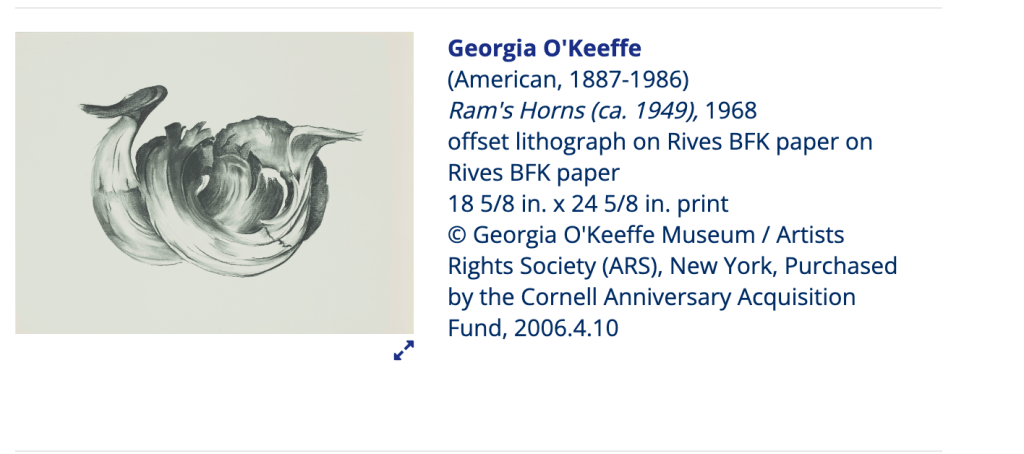
Using art in a science class can re-engage students in a topic that may feel difficult to understand or uninteresting, especially in difficult subjects like physics. Art and science have been important companions particularly in the natural sciences. As an example from some of the selected works, Georgia O’Keeffe’s lithographs in the RMA collection are wonderful examples of how understanding the structures that make up the natural world can be done through artistic renderings. For hundreds of years, scientists have needed an artistic eye to describe the world around them; from sketches of anatomy, to paintings of animals, to the grand view of the cosmos.
While not a particularly divisive topic, this is a theme that has the potential to have more widespread use in the coming years and hopefully allows teachers a resource of information that they can freely utilize to engage students in art history while collaborating with outside institutions like the Rollins Museum of Art.
Bibliography
O’Keeffe, Georgia. “Ram’s Horns (ca. 1948),” Offset Lithograph on Rives BFK Paper, 1968, (Rollins Museum of Art), https://www.rollins.edu/rma/collection/art-since-1950/index.html#GeorgiaO’Keeffe.

 Baking the Past
Leave a comment