Digital History as a field has the unique opportunity to investigate the past with a wide-range of applications and tools that can be used to analyze incomprehensible amounts of information. Given the reliance that many of us have on the digital world today, I find the use of digital technologies and the breakdown of information into easy-to-understand quantitative figures and graphs to be a fascinating subject.
For my experiment in big data, I chose to use my favorite big data tool: Constellate, also known as JSTOR on Research to try to find out if I could locate more contextual information about agricultural schools and the agriculture at the end of the 19th century, beginning of the 20th century. While this information ties directly into my thesis, I think that it would also be applicable to the research I plan to do on the Hungerford School, because it would provide more of a historiography on the scholarship done about the agricultural schools in the South and what sorts of content would be part of the curriculums at schools like Hungerford. This is essential information because it provides a foundation that will assist in analysis of inventory checklists in primary sources like the Hungerford Deed and the Annual Reports.
For my first dataset, I created a search using the general terms “environmental history,” “food,” and “agroeconomy.” My hope was that I could initially filter JSTOR for a paper that I was already planning on using in another assignment and a jumping off place for my digital research, and was hoping would be included in the search, as a sort of litmus test for the software (Donald Worster’s landmark paper “Toward an Agroecological Perspective in History,” 1990). Constellate breaks down articles using term frequency, so I used the key terms from this specific article I was filtering for.
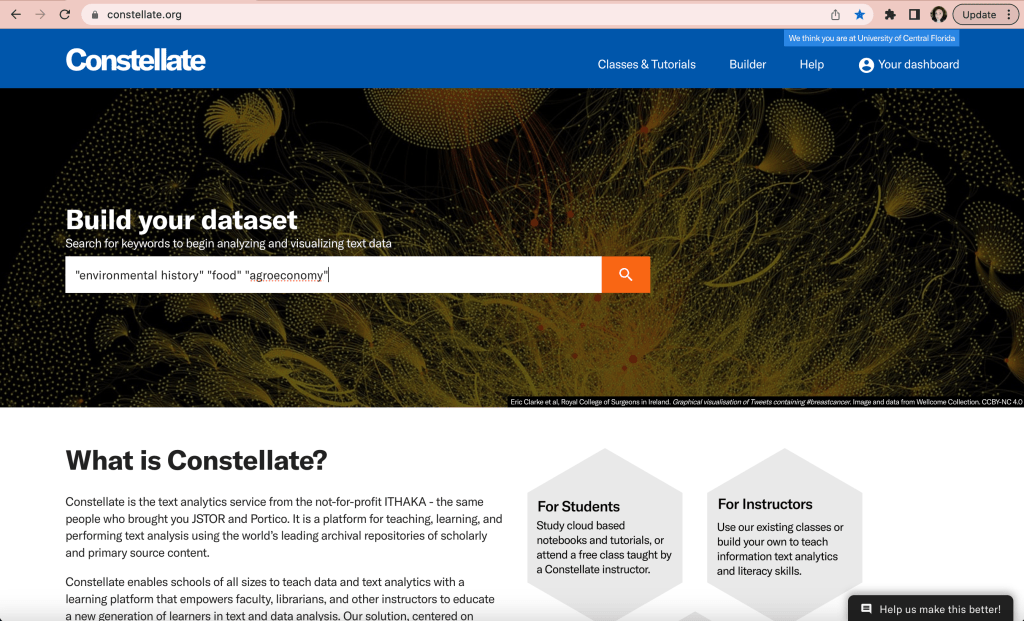
Despite my hopes that I had created a good basic dataset, the algorithm misunderstood my search terms and filtered for biology papers instead, interpreting “agroeconomy” as “amphibian.” Of the nine papers that Constellate located, eight of them were from the journal Conservation Biology and the only one that was a history paper from the journal Latin American Perspectives.

Realizing that I might have to adjust my searches, I searched for “agricultural history,” “industrialization,” and “environmental history.” This search was more successful. From this search I located 2,593 articles pertaining to the lens of history I wanted to focus on and it took me to a list of documents that I could sort through that focused on the niche group of articles I was looking for. One of the most interesting ones include articles focusing on agricultural education done at land-grant universities.

While there are search and filter tools on JSTOR’s actual website, the Constellate method of searching, and the links to direct articles makes it an appealing option for researching the extensive list of articles that JSTOR has on its database. In addition to seeing the number of articles, one can also find the years that certain terms first appeared in scholarly publications. This is important from a historiographical perspective because it allows for me to gauge the lifespan of different interpretive trends. This is important when searching for the larger themes within research or seeing the gaps in the field.
Bibliography
Graham, Shawn, Ian Milligan, and Scott Weingart. “Ch. 1 The Joys of Big Data for Historians.” In The Historian’s Macroscope: Big Historical Data. London: Imperial College Press, 2016.

 Baking the Past
Leave a comment