I’m so excited, the first of my food history curricula has been completed and turned in with its first run scheduled for next month! As I briefly mentioned in last week’s blog, for the past two weeks I’ve been researching the food history of the Middle Ages. This topic was both a great warm-up for what is to come and close to my heart. In undergrad, I took over 18 hours of classes on the medieval period and fell in love with food history through my focus on the topic. It was during these classes that my professors encouraged me to search for sources pertaining to my interests and write papers connecting them to the topics that we were studying. During my undergrad career I wrote papers on the impact of the Crusades on the spread of spices and, the paper that became the basis for the curriculum I created for my internship, feasting and fasting in the Middle Ages.
I chose this breakdown of the topic for a couple reasons, firstly it was a topic I already had multiple books and written bibliographies on, secondly this enabled me to introduce medieval foodways in a logical way that would build on itself, sharing contextual information about life in the medieval era, then framing the impact of farming and ingredient availability as well as some foundational information about the food system itself. Then I moved onto food preparation with a brief overview of the food processing setup at upper class homes, think castles and manor houses, and then described the patterns of feasting and fasting.
When formatting my curriculum, I started with a summary of the period itself, to orient myself and the educators in what they would be looking at. I then moved onto what the main takeaways from the lesson should be, as well as suggestions for hands-on activities or demonstrations that might be good to include in the class. Unfortunately, with the time limits on demonstrations, it was incredibly difficult to find something that would work, I eventually suggested Almond Milk, which is in fact from the medieval period!
One of the biggest challenges that I had over the course of my writing was finding a way to blend the information that I had in my head from previous research and experience with the introductory information that would be required for another educator to teach the information I was sharing. I had to keep reminding myself that the person reading what I was writing didn’t hadn’t read the same books that I did and may not know that tracts of farmland were known as “hides.” I ended up with about 8 pages of educator notes featuring historical context and links to public history sites, book reviews, open-source texts, and videos on the cuisine of the Middle Ages. I also added an additional selected bibliography with the books that I referenced throughout my notes.
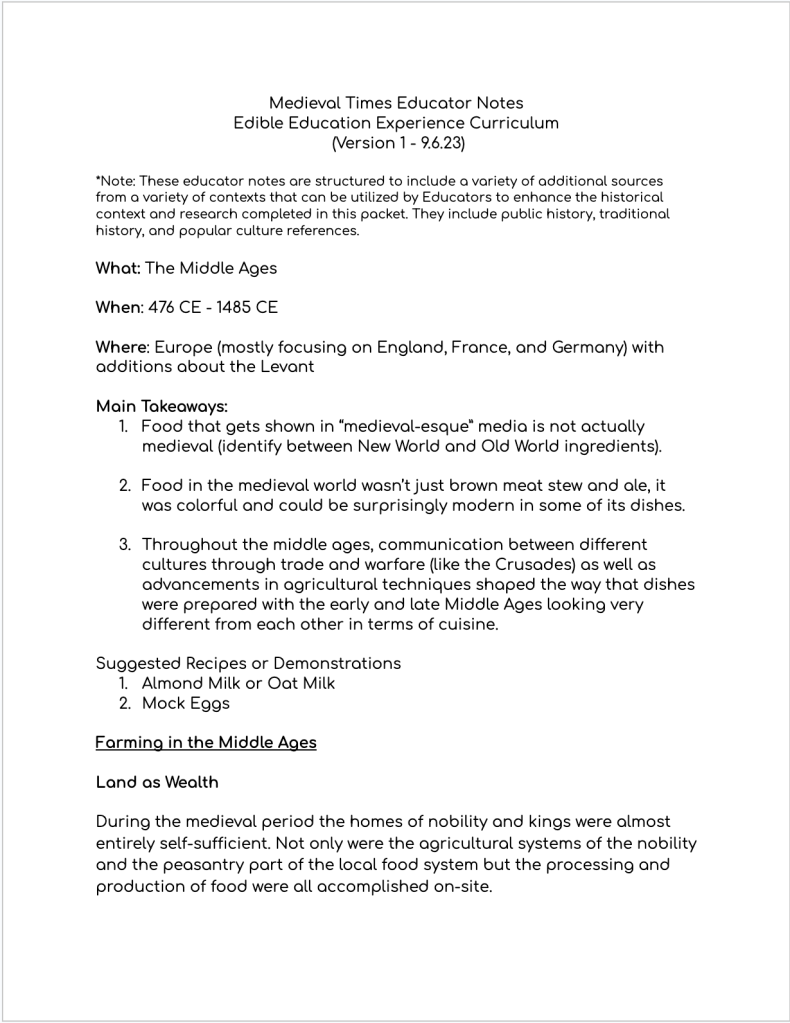
After turning in my curriculum, I also dropped by the Kitchen House in the middle of the week to finish getting paperwork filled out, and looking over my packet with Megan. Now I’m getting ready to start building another packet for a topic I am less familiar in but equally excited about: Southern Food. I’m hoping to throw in some local history with this topic, and bring in some information about the Extension Service as well as some of Orlando’s oldest restaurants. I have a spreadsheet that I’ve been saving as a personal pet project that details a brief history of over 55 restaurants across Florida with many of them right here in the City Beautiful.

 Baking the Past
Leave a comment