This past Thursday, I got to see the first of the curriculums I’ve created in my internship this fall come to life. After last week’s trial by fire (well induction burner) I was super excited to get back to the typical format of Education programs; getting the chance to share information over a longer length of time with the few hours we had to teach split into the different sections of Front Room Demonstration, Garden Education, Kitchen Education, Meal.
This group was one of 11 students around 8-13 in age and all of them were part of a homeschool group. In my experience, homeschool groups are a very interesting audience to teach. You have a variety of different ages in one group, all learning the same material, which means you have to tailor what you say very carefully: it needs to be understandable to the younger students but still interesting enough for the older students, so everyone stays engaged, and in a safety critical environment like a kitchen, everyone pays attention to what they’re doing.
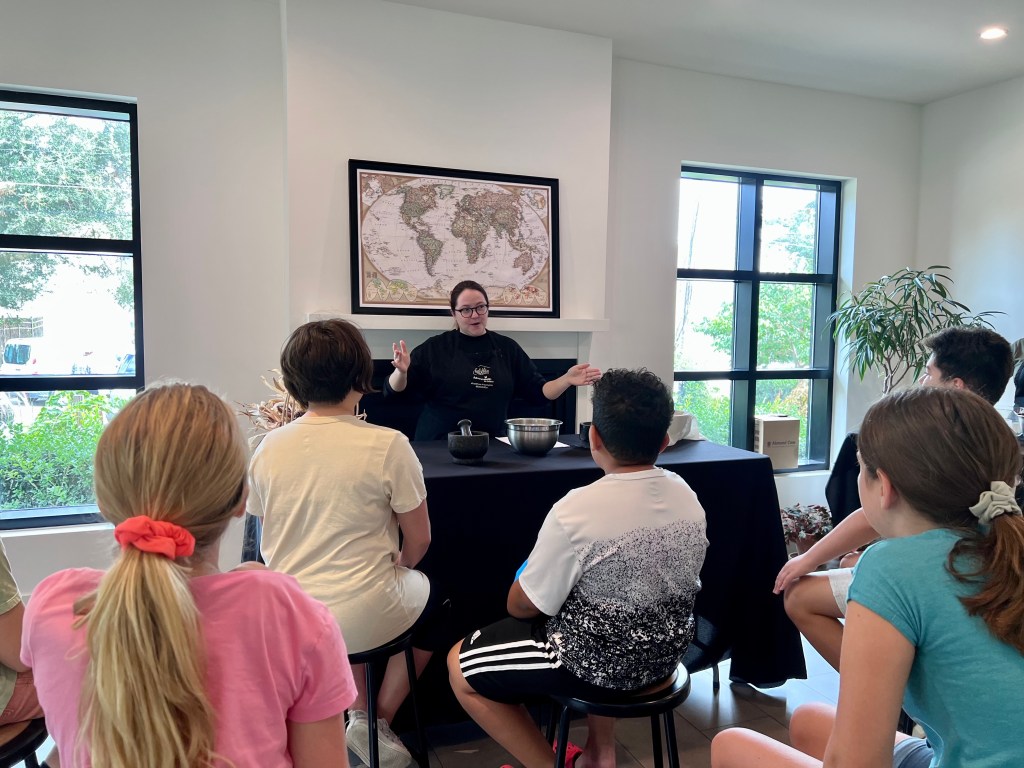
Thursday’s program had the perfect ratio of adults to students and with multiple educators splitting up the work, we moved quickly and efficiently through the demonstration, the garden, and into the kitchen. I lectured for about 20 minutes, giving background on medieval food, feasting, fasting, and agriculture. Trying to tie in interesting facts and a cohesive story that would be helpful later on in the kitchen. I was extremely grateful that Gina, our incredible Culinary Educator and Megan, my supervisor and the Education Coordinator were there to assist in the demonstration so we could keep all 11 students focused on the demonstration that we did, which ended up being almond milk. It went fine. We stayed on time and were able to make it to the Garden education section on time, but by the time we got to the demonstration I was struggling to keep the group’s attention while they waited to grind almonds for the almond milk. I also asked Gina to show how the electric Almond Cow worked way earlier than I should have, which limited the effectiveness and cool factor of the technology. It could have been a much better demonstration.

Reflecting on how this program went, there are definite improvements that could be made to the way that the curriculum is structured. I added a lot of background research that, while good for an educator to have, isn’t necessary for teaching the class itself. In addition, there is an obvious way for the demonstration to be tailored to make it more engaging and more cohesive while still maintaining control over the group. First, I would recommend a restructuring of the information. I didn’t structure it correctly. All of the information on ingredients and agriculture needs to be at the top of the lesson. Then, we move into feasting, land as wealth, and talk about forests and the idea of medieval Kings giving gifts of deer as “helping out with the grocery shopping for feasts.” Then, we move into fasting, we talk about food substitutes and then we talk about almond milk.

We talk about how people made almond milk and we have someone come up and try to grind the almonds using a mortar and pestle. Then we move over to the Almond Cow. We ask which one the students think will be more efficient in making almond milk. We have them vote/pick a team. Then we time it. This will keep the demo fast-paced, students will stay engaged, and hopefully there won’t be any yelling about what is and isn’t a fish like there was on Thursday.

 Baking the Past
Leave a comment